Custom Web Development: Cost, Process, and FAQs (2026)
Custom web development is the process of designing and building a website or web application from scratch to fit one business’s goals, users, and workflows, instead of starting from a pre-made template or a drag-and-drop website builder. Every layout, feature, and line of code is created for your needs. In 2026, a basic custom website typically costs between $5,000 and $15,000, while complex web applications can run from $50,000 to well over $250,000.
If you are a business owner or beginner who wants a professional website built without learning to code, this guide is for you. It explains what custom web development really means, how it compares to website builders and WordPress themes, what the typical process looks like, what drives 2026 costs, and how to hire the right developer or agency.
Key Takeaways
- Custom web development builds a website or web app from scratch for your business, not from a template.
- 2026 prices: roughly $5,000-$15,000 basic, $15,000-$75,000 mid-range, $75,000-$250,000+ enterprise; wide regional variation.
- Timelines: 6 to 12 weeks for most sites, 3 to 12 months for web applications.
- Biggest advantages: performance, SEO control, scalability, and full code ownership.
- A template or builder wins for simple brochure sites, tight budgets, and rush launches.
- Get code ownership, milestone payments, and post-launch support in writing before signing.
Table of Contents
- What Is Custom Web Development?
- Custom Web Development vs Website Builder: Which Should You Choose?
- What Does the Web Development Process Look Like, Step by Step?
- What Technologies Do Custom Developers Use?
- What Is the Cost of a Custom Website in 2026?
- How Long Does a Custom Website Take to Build?
- What Are the Benefits of Custom Web Development?
- When Is a Website Builder or Template Enough?
- How Do You Choose a Web Developer or Agency?
- Custom Website Development Examples: What Can Businesses Build?
- Frequently Asked Questions
- Conclusion
What Is Custom Web Development?
Custom web development is the service of planning, designing, and coding a website or web application for one organization’s goals, content, and users. Instead of starting from a pre-made theme, the team decides the architecture, design, and features from scratch and writes the code to match.
A typical project covers strategy, custom UX and visual design, front-end and back-end development, a CMS your team can use, integrations like your CRM or payment provider, testing, launch, and support.
One note: “custom” rarely means reinventing every wheel. Modern bespoke websites use proven building blocks like React or Next.js plus established payment and search services. What is custom is how those pieces are chosen, designed, and connected for your business. Installing a WordPress theme and changing colors is not custom development.
Custom Web Development vs Website Builder: Which Should You Choose?

The custom web development vs website builder decision is the first fork in the road:
| Factor | Custom Build | Website Builder (Wix, Squarespace) | WordPress Theme |
|---|---|---|---|
| Upfront cost | Higher ($5,000+) | Low (monthly subscription) | Low to medium ($2,000-$10,000 with setup) |
| Design flexibility | Unlimited | Platform-limited | Theme-limited |
| Performance | Clean, optimized code | Often JavaScript-heavy | Often bloated by plugins |
| SEO control | Full control | Good basics only | Strong with the right setup |
| Scalability | Built to grow | Hits a ceiling | Good, with maintenance |
| Maintenance | Predictable | Handled by the platform | Plugin updates and fixes |
| Ownership | You own code and data | Weak portability | You own site and content |
| Time to launch | Weeks to months | Days | Days to weeks |
Choose custom when your website is central to how you sell, when you need functionality templates cannot deliver (calculators, portals, booking systems, custom integrations), or when you expect years of growth.
Choose a website builder for a simple site fast on a tight budget. Builders suit micro-businesses getting online this week, but SEO control is limited and portability is weak: leaving Wix later means rebuilding from scratch, which gets pricier as you grow.
Choose WordPress with a theme as the middle path: more flexible than a builder, cheaper than full custom. The catch is maintenance, since every plugin is another dependency to update.
What Does the Web Development Process Look Like, Step by Step?
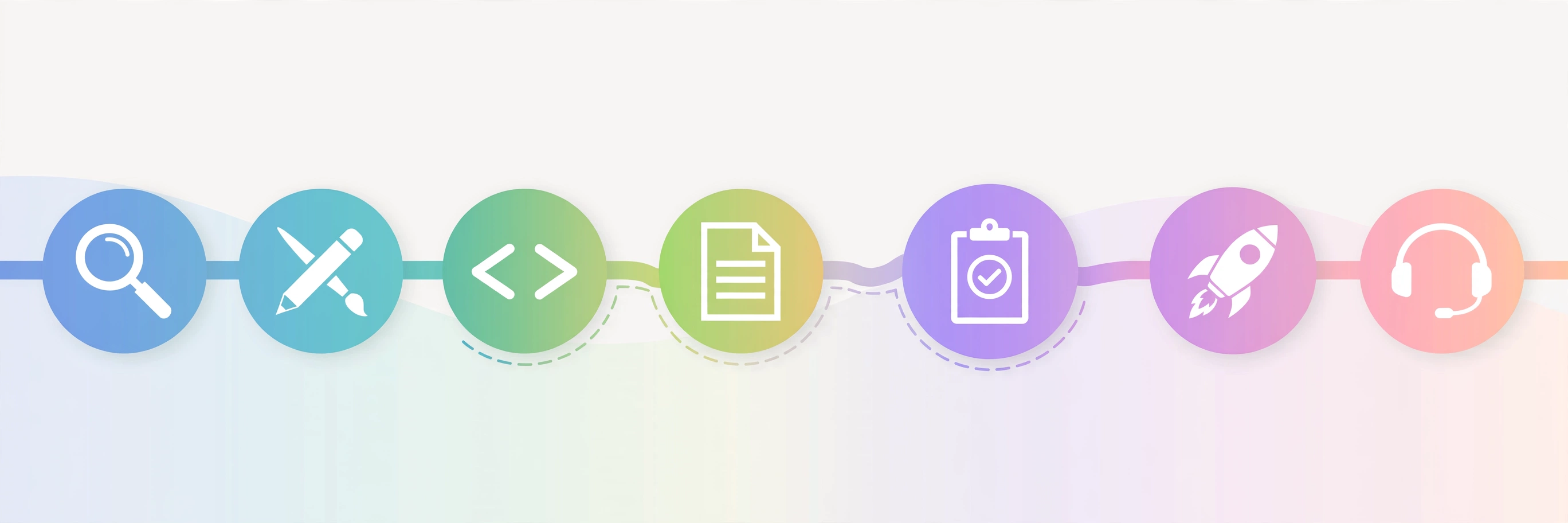
Every serious agency follows roughly the same path. Knowing the steps shows what you are paying for and where projects go wrong.
1. Discovery and strategy. Goals, audiences, and constraints are defined through interviews, competitor analysis, and sitemap planning. Discovery is typically 10 to 15 percent of the project cost, and skipping it is the most reliable way to double your budget later.
2. Design. Designers create wireframes, then visual designs and clickable prototypes, usually in Figma. A design system of reusable components keeps the site consistent. You approve the look before code is written.
3. Development. Developers build the front end and back end in short iterations, so you see working software early. This is the longest phase and the largest share of the budget.
4. Content and migration. Content goes in, old pages are cleaned and migrated, and old URLs map to new ones with 301 redirects so rankings survive. Skipped redirects are where most rebuilds fail.
5. Testing and launch. The site is tested across devices and browsers, then comes DNS cutover and monitoring, with a support window for issues that surface with real traffic.
6. Support and maintenance. Budget 15 to 25 percent of the build cost yearly for hosting, security patches, and improvements.
Before contacting anyone, prepare a brief: goals, budget range, sites you like, must-have features, and who provides content. It gets you faster, comparable quotes.
What Technologies Do Custom Developers Use?
You do not need to code to hire a developer, but knowing the names helps. The partner matters more than the technology, but the stack should fit your requirements, not the agency’s habits.
Front end: HTML structures the page, CSS styles it, JavaScript makes it interactive. Most builds add a framework: React is the most widely used, Next.js adds performance and SEO-friendly rendering, and Vue is a popular alternative.
Back end: Node.js runs JavaScript on the server. Python, often with Django, suits data-heavy apps. PHP, often with Laravel, powers a huge share of the web. PostgreSQL or MySQL typically store content, users, and orders.
Content and commerce: Many custom sites use WordPress as a headless CMS while a modern front end displays the content. Shopify is the default for online stores. Figma handles design, GitHub holds version control: if an agency cannot show you a repository with your code, ask why.
AI in 2026: AI coding tools changed build speed, not responsibility. Serious teams use AI in a supervised pipeline with developers reviewing every change. Ask who reviews the code, and be wary of “vibe coding,” where AI generates an app nobody understands.
What Is the Cost of a Custom Website in 2026?

Website development cost in 2026 depends on what you build, who builds it, and where they are based. Treat every number as a range.
| Project Tier | Typical Investment | Who It Is For | Timeline |
|---|---|---|---|
| Basic custom website | $5,000-$15,000 | Startups, small businesses, 5-10 pages | 3-6 weeks |
| Mid-range custom build | $15,000-$75,000 | Growing B2B, SaaS sites with integrations | 6-12 weeks |
| Enterprise or complex site | $75,000-$250,000+ | High-traffic sites, portals, complex projects | 3-6 months |
| Custom web application | $50,000-$300,000+ | SaaS products, platforms with user accounts | 3-12 months |
These bands line up across current sources: a 2026 cost guide from CurioDigital places basic custom sites at $5,000-$15,000, mid-range builds at $15,000-$75,000, and enterprise work at $75,000-$250,000+, while agency Netguru’s 2026 figures put custom web applications between $15,000 and $300,000+.
What drives the price? Scope, design depth, integrations (each CRM, payment, or API connection adds work), backend complexity, migration volume, SEO requirements, and timeline pressure.
Who you hire changes the math. A freelance web developer typically charges $50 to $150 per hour in the US, strong value for projects you manage yourself. Agencies bundle strategy, design, development, QA, and project management. In-house only pays off with continuous work: the U.S. Bureau of Labor Statistics lists median developer pay at $90,930 a year (May 2024), before benefits.
Ongoing costs. Budget 15 to 25 percent of the build cost yearly for hosting, security, and improvements. Compare total cost of ownership over three to five years, not the initial invoice.
How Long Does a Custom Website Take to Build?
A focused 5 to 10 page custom site can ship in 3 to 6 weeks. Most mid-range builds take 6 to 12 weeks. Enterprise sites run 3 to 6 months, and full web applications typically take 3 to 12 months.
Timelines slip on content and feedback, not coding. Assign one decision-maker and deliver content before development starts. Be wary of anyone promising a complex custom build in an unrealistically short time.
What Are the Benefits of Custom Web Development?
The benefits must justify the higher cost. For the right project, they compound.
Performance. Custom builds ship the code your site needs. In a 2020 Deloitte study for Google, brands improving four load-time metrics by 0.1 seconds each saw retail conversions rise 8.4% and lead-form progression rise 21.6%.
Full SEO control. Clean code, fast loads, and structured data usually need custom work. New to SEO? Start with our SEO beginners guide, then read our guide to semantic SEO.
Scalability and security. A custom architecture grows with your business, and fewer plugins means fewer vulnerabilities.
Ownership. You own the code and can move it to another team or host.
Brand differentiation. The design starts from your brand, not a layout thousands of businesses share.
When Is a Website Builder or Template Enough?
Custom web development is not right for every project, and honest agencies say so. A template or builder wins when you need a simple brochure site quickly, your budget is tight, you are testing an idea, or nobody will maintain the site afterward. Five pages and a contact form do not justify $10,000 of custom code.
One caution: starting with a template and upgrading later gets pricier as content, traffic, and integrations grow. If you expect to need custom functionality within a year or two, factor the rebuild into today’s decision. WordPress offers more data portability than a closed builder.
How Do You Choose a Web Developer or Agency?
The partner matters more than the technology.
Green flags: a portfolio of live sites with case studies; clear communication from the first call; a discovery phase before a fixed quote; transparent pricing; willingness to challenge your ideas; and two references from similar-sized projects.
Red flags: a $500 quote for a full custom site; guaranteed #1 Google rankings; no written contract covering scope, milestones, and ownership; full payment upfront; no portfolio or references; and pressure tactics like “this price is only good today.”
Get ownership in writing. The contract should state you own the code repository, hosting account, CMS, and domain, all in your name from day one. Ask to see the GitHub repository during the project. Confirm support costs, bug-fix handling, and what happens when scope changes.
Curious about building it yourself? Our roadmap on how to learn web development covers a realistic path from beginner to job-ready.
Custom Website Development Examples: What Can Businesses Build?
The more complex the project, the more custom work becomes software development. Real examples: agency Ikius built BankGrader, a bank comparison tool with its own data and logic, and Laturikotiin.fi, an EV charger platform routing quote requests to electricians. No template could deliver either.
For small businesses, picture these scenarios (illustrative): a dental clinic with online booking and a patient portal; a clothing brand with a 3D configurator tied to Shopify; a consultancy with an ROI calculator feeding its CRM. If a template could do it reliably, you do not need custom development.
Frequently Asked Questions
How much does custom web development cost in 2026?
Basic custom websites run $5,000 to $15,000, mid-range builds $15,000 to $75,000, and enterprise sites or web applications $75,000 to $300,000 or more. Freelance rates are usually $50 to $150 per hour. Prices vary by region, so compare quotes against the same written scope.
How long does it take to build a custom website?
Most custom sites take 6 to 12 weeks; small 5 to 10 page sites can ship in 3 to 6 weeks. Web applications typically take 3 to 12 months. Delays usually come from slow content and feedback, not coding, so prepare content early.
Is custom web development better than WordPress?
It depends. WordPress is flexible, affordable, and excellent for content-driven sites, and many custom projects use it as the CMS. Full custom wins for unique functionality, strict performance or security needs, or distinctive design. For simple sites, WordPress with a good theme is the smarter buy.
Can I update a custom website myself without a developer?
Yes, with a proper CMS. A well-structured CMS lets your team publish posts, swap images, and edit landing pages without a developer. Structural changes and new integrations still need one. Ask any agency to demo the content editor before you sign.
Who owns the code after a custom build?
You should, and the contract must say so. Insist on owning the code repository with GitHub access during the project, plus hosting, CMS, and domain in your name. That lets you change developers without rebuilding, so never let an agency hold your site hostage.
What should I prepare before contacting a web developer?
Prepare your goals, a realistic budget range, examples of sites you like, must-have features and integrations, and your content or a plan for who writes it. A clear brief gets you faster, comparable quotes and protects against scope creep.
Conclusion
Custom web development means building your website or web application from scratch around your business goals, not squeezing your business into a template. It costs more and takes longer than a website builder, with 2026 projects typically ranging from about $5,000 for a basic custom site to $250,000 or more for complex applications. In return you get performance, SEO control, scalability, security, and full ownership of your code.
Next step: write down what your website must achieve, gather examples you admire, and get scoped quotes from two or three developers. Use the red flags and ownership checklist in this guide to compare them fairly. For more beginner-friendly guides on getting your business online, explore CPN Tech.