What Is Agentic AI? A Simple Explanation for Beginners
Agentic AI is artificial intelligence that can take a goal and work toward it on its own: planning steps, using tools such as web search or calendars, checking results and adjusting its plan until the goal is done. A chatbot answers one question, while agentic AI runs a whole task from start to finish with limited human input.
This guide explains what agentic AI is in plain language. It covers how agentic AI works through a five step loop, how it differs from AI agents, generative AI and traditional AI, real examples from coding, support and research, a step by step walkthrough of one task, the main risks and guardrails, and when agentic AI is the right choice. By the end you will know what agentic AI means, what it can do and where its limits are.
Key Takeaways
- Agentic AI is AI that pursues a goal on its own through planning, tool use and self correction, not one prompt at a time.
- Every agentic system runs the same five step loop: Perceive, Reason, Plan, Act and Learn.
- An AI agent is one worker; agentic AI is the whole autonomous operation, often several agents at once.
- Agentic AI shines at multi step tasks like research, coding help and trip planning; a chatbot is enough for single answers.
- Autonomy brings risks: runaway loops, wrong actions and hidden costs, so guardrails and human approval gates matter.
Table of Contents
- What Is Agentic AI?
- How Does Agentic AI Work?
- What Is the Difference Between Agentic AI, AI Agents, Generative AI and Traditional AI?
- What Are Real Examples of Agentic AI?
- What Does an Agentic AI Task Look Like Step by Step?
- What Are the Risks and Limits of Agentic AI?
- When Should You Use Agentic AI, and When Should You Not?
- FAQs
- Conclusion
What Is Agentic AI?
Agentic AI is artificial intelligence that takes an objective and works through whatever steps are needed to reach it, instead of waiting for one prompt at a time. A chatbot answers a question and stops. An agentic system keeps going: it reads data, calls tools, checks results and changes course, until the objective is complete. The word agentic comes from agency, the ability to act on your own toward a goal.
In AI research, agentic AI is a specialized subset of intelligent agents: systems that perceive an environment, pursue goals and improve with experience. Three traits separate agentic AI from earlier AI. The system pursues goals across many steps, not one turn. The system uses external tools such as search, calendars and databases. The system evaluates its own output and decides whether to continue or stop.
A short test tells you if a tool is agentic. Give it an objective like “summarize this week’s tech news and save the best three stories.” If the tool asks one question, answers and stops, it is a chatbot. If the tool finds the news itself, picks the stories and saves them, it is agentic. If you want more beginner explainers like this one, browse the Artificial Intelligence category on CPN Tech.
How Does Agentic AI Work?
Agentic AI works through a five step loop: Perceive, Reason, Plan, Act and Learn. The loop runs once for a simple task and dozens of times for a complex one. Each phase feeds the next, and the system returns to the start when results fall short.
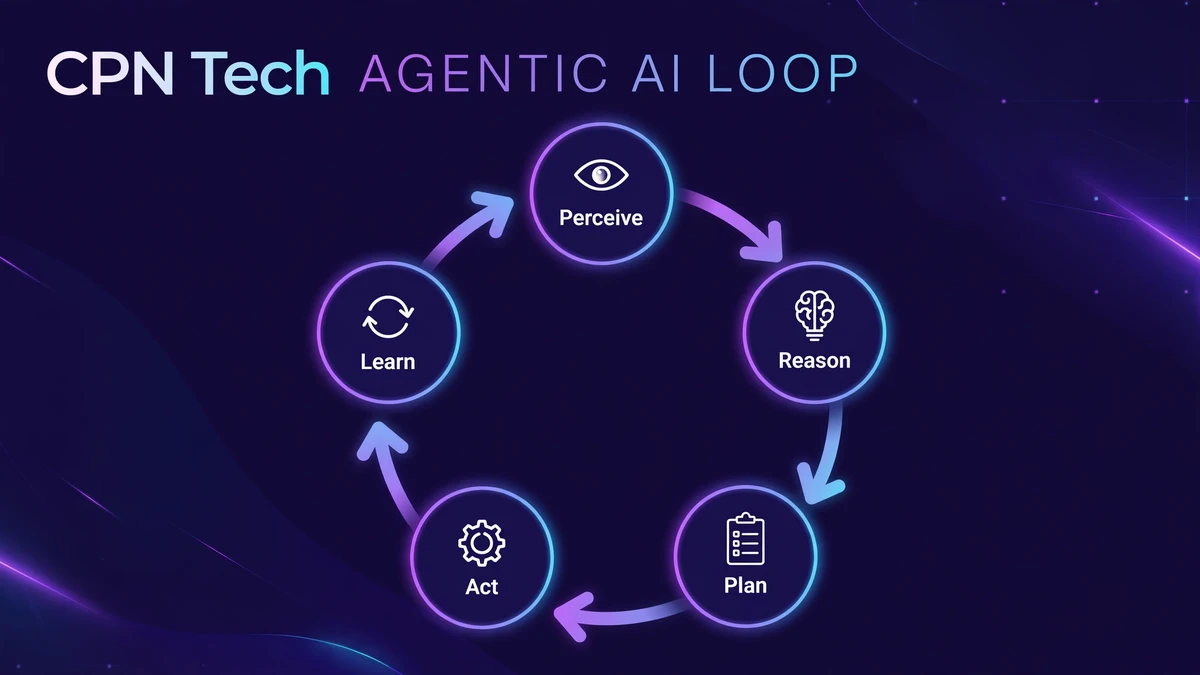
The five phases of the loop are:
- Perceive: the agent reads documents, web pages, databases and sensor data.
- Reason: the agent interprets the data and identifies what is known and what is missing.
- Plan: the agent breaks the goal into steps and chooses the tools for each step.
- Act: the agent calls application programming interfaces (APIs), writes files and sends messages.
- Learn: the agent checks the result, stores what worked and adjusts the plan.
The reasoning step uses frameworks such as ReAct (Reason plus Act), described by Yao et al. in 2022, which interleaves thinking and acting instead of treating them as separate stages. For tool access, many systems now use the Model Context Protocol (MCP), an open standard that gives agents one consistent way to discover and call tools. Taskade reported more than 60,000 open-source MCP projects in early 2026 (Source: Taskade, 2026).
In my own testing, giving an agent one clear goal with a deadline produces far better results than handing it a vague project.
Try the free AI Prompt Generator from CPN Tech to write clear prompts for any AI assistant.
What Is the Difference Between Agentic AI, AI Agents, Generative AI and Traditional AI?
Agentic AI is the whole autonomous operation, an AI agent is one worker inside it, generative AI creates content one prompt at a time, and traditional AI follows fixed rules. The four terms describe different layers, and mixing them up causes most of the confusion around this topic.
| Agentic AI | AI Agent | Generative AI | Traditional AI | |
|---|---|---|---|---|
| Core job | Reach a goal on its own | Finish one defined task | Create text, images or code | Decide by fixed rules |
| Interaction | Set a goal, get a result | Give an instruction, get an action | Ask a question, get an answer | Feed input, get output |
| Tool use | Many tools across many steps | A few tools for one task | None beyond the prompt | None |
| Planning | Dynamic multi-step plans | Short plans for one task | No planning | Decision trees only |
| Example | Trip planned and booked end to end | Support bot that checks an order | Email draft from a chatbot | Spam filter |
A useful way to read the table is through the user experience. Traditional AI waits for input and applies one rule. Generative AI waits for a prompt and returns content. An AI agent accepts one instruction and takes one bounded set of actions. Agentic AI accepts an objective and manages the entire workflow.
Agentic systems are built on top of large language models (LLMs), the same technology behind chatbots such as ChatGPT, Claude and Gemini (see the large language model overview on Wikipedia). The language model supplies the reasoning and language skill, while the surrounding system adds memory, tools and the control loop that make the behavior agentic.
What Are Real Examples of Agentic AI?
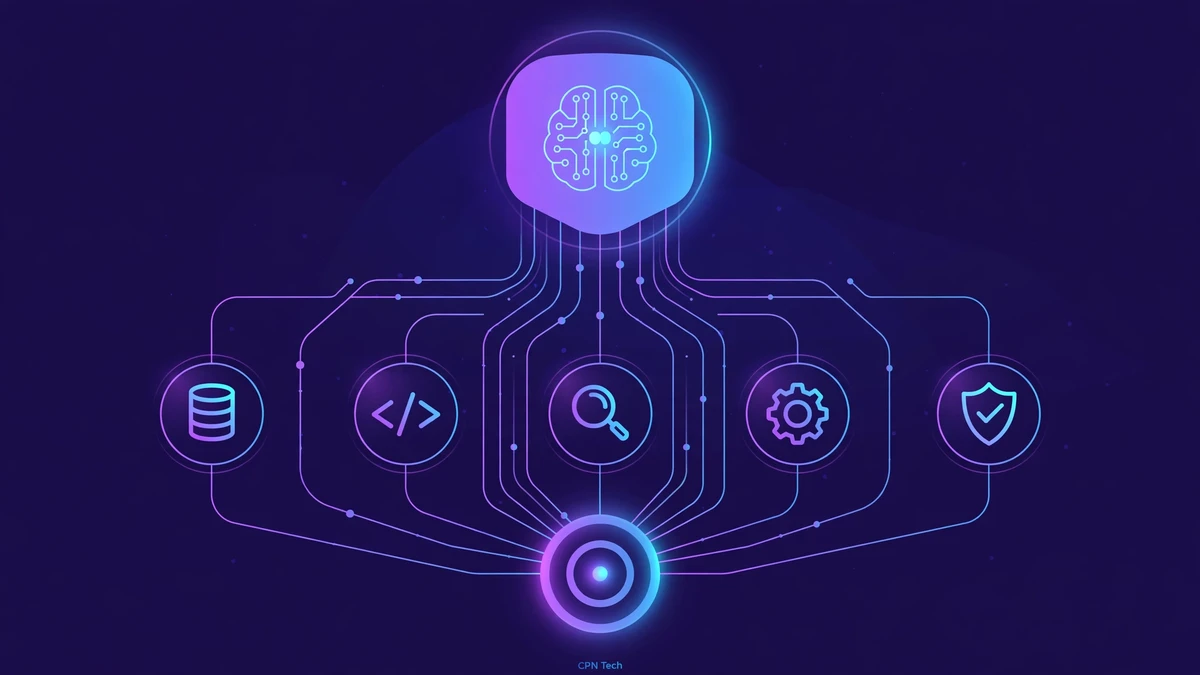
Real examples of agentic AI include coding agents that fix bugs, research agents that write reports and support agents that resolve tickets end to end. Each example follows the same loop; only the tools change.
Software development. A coding agent takes a bug report, reads the codebase, identifies the root cause, writes a fix, runs the tests and opens a pull request. The developer reviews the result instead of writing every line.
Customer support. A support agent reads the ticket, searches the knowledge base, checks the account through an API, drafts a reply and escalates to a human when confidence is low. The customer gets one smooth answer instead of three separate replies.
Research. A research agent takes a broad question, searches databases and the web, compares findings across sources and writes a structured report with citations. Work that takes a human analyst hours arrives in minutes.
Business operations. Travel and logistics teams use agents to rebook itineraries, predict inventory and reroute shipments when delays appear. NorthBay reported 20 to 30 percent higher booking conversion and up to 40 percent lower support costs after adopting agentic booking tools (Source: AWS, 2026).
Gartner projects that 33 percent of enterprise software will include agentic AI by 2028, up from less than 1 percent in 2024 (Source: Gartner, 2026). IDC projects that 80 percent of enterprise applications will incorporate AI agents by 2026 (Source: IDC, 2026). These numbers explain why the term shows up in almost every vendor pitch this year.
What Does an Agentic AI Task Look Like Step by Step?
An agentic AI task starts with one clear goal, then the system loops through perceiving, reasoning, planning, acting and learning until the goal is done or it needs your input. Here is a realistic walkthrough of a personal trip task.
- Set the goal: “Plan a weekend trip for two under $300, departing Friday.”
- Perceive: the agent reads your calendar and blocks out your free weekend.
- Reason: the agent searches flights and hotels, then compares prices against the budget.
- Plan: the agent drops a hotel that exceeds the budget and picks the next best option.
- Act: the agent holds the booking and waits for your payment approval.
- Learn: the agent checks the weather forecast and adjusts the day plan around rain.
- Report: the agent writes a short itinerary and lists every cost with receipts.
- Confirm: the agent asks for your approval before spending anything, then finalizes the plan.
Notice what the agent never did: it never asked which sites to visit or which buttons to click. It asked for approval only where money moved. That pattern, autonomy inside limits plus approval at the money step, is the shape of safe agentic AI.
What Are the Risks and Limits of Agentic AI?
The main risks of agentic AI are runaway loops, wrong actions on bad data, prompt injection and spiraling tool costs. Autonomy multiplies both the good and the bad, so every risk below deserves a guardrail.

Runaway loops. An agent without a stop condition can retry a failing step for hours and burn tokens or API calls on nothing. Set a maximum number of attempts and a time limit, if the agent works unsupervised.
Wrong actions. An agent acts on the data it reads, and bad data produces bad actions. A misread calendar entry can book the wrong day; a wrong record can message the wrong person. Limit which systems the agent can touch, if a mistake costs money or trust.
Prompt injection. An agent reads web pages and documents that anyone can edit, and hidden instructions in that text can hijack the task. Treat everything the agent reads as untrusted input, even when it looks like a normal page.
Costs. Every loop step calls a model and often an API, and complex goals can burn hundreds of calls. Track spending per task and set budgets, if you run agents on metered APIs.
Memory mistakes. Agents with persistent memory remember past steps, which is useful until they remember something wrong. Review stored memory the same way you review the output, if the agent keeps state across sessions.
The standard guardrails are simple: tight permission scopes, approval gates before payments or messages, full logs of every action and a kill switch that stops the agent instantly.
When Should You Use Agentic AI, and When Should You Not?
Use agentic AI for multi step tasks with a clear goal; skip it when a single answer or a fixed rule does the job. The decision takes ten seconds and saves hours of bad fit.
Use agentic AI when the task spans many steps and tools, for example research reports, weekly monitoring with actions, or multi file coding help. Use it when the goal is clear but the path is open, and when you can review the result before it goes out.
Skip agentic AI when a chatbot answer is enough, when a simple script or spreadsheet rule already solves the problem, or when the goal itself is vague. A vague goal produces a confident wrong result, which is worse than no result. If you are still learning what AI tools can do, start with our guide on how to use AI for everyday tasks.
FAQs
What is the difference between agentic AI and an AI agent?
An AI agent is one program that combines a language model with tools to finish a defined task, such as answering a support email. Agentic AI is the broader system that pursues a goal with autonomy, often by coordinating several AI agents at once. In short, an AI agent is the worker and agentic AI is the whole operation.
Is agentic AI the same as generative AI?
No. Generative AI creates content one prompt at a time, such as text, images or code. Agentic AI uses a generative model as one part of a larger system that also plans steps, calls tools and completes tasks. A chatbot is generative; a system that books your trip is agentic.
Do I need to know coding to use agentic AI?
No. Many agentic features are already built into apps you use, such as research assistants and coding helpers. No code platforms also let you build simple agent workflows with forms and settings. Coding only becomes necessary when you build custom agents or connect them to private systems.
Is agentic AI safe to use?
Agentic AI is as safe as the guardrails around it. Keep permission scopes tight, require human approval before payments or messages, and review the action logs. Never give an agent full access to sensitive accounts or company data, and always keep a kill switch within reach.
What is an everyday example of agentic AI?
A travel planning assistant is a good example. It checks your calendar, compares flights and hotels, books within your budget and adjusts when prices change. Coding helpers that fix bugs and research assistants that write reports work the same way: you set the goal and the system handles the steps.
What is the biggest limitation of agentic AI right now?
Reliability. Agents still misread instructions, call the wrong tool and loop without finishing. Every step also costs tokens or API calls, so complex tasks need monitoring, clear stop conditions and spending limits. Human review remains a requirement, not an option.
Conclusion
Agentic AI turns AI from a question answerer into a task finisher: it takes a goal, plans steps, uses tools and adjusts until the work is done. The five step loop, Perceive, Reason, Plan, Act and Learn, is the same in every system, from coding helpers to travel planners. The risks are real but manageable with tight permissions, approval gates and clear stop conditions. To keep learning, browse more beginner guides on the CPN Tech homepage.
Explore the free tools hub: CPN Tech tools include prompt generators, calculators and helpers that run in your browser with no signup.