Examples of 5G: 15 Real Uses Explained Simply
Most people first meet 5G as a small icon at the top of a phone screen. That icon tells only part of the story. Behind it sits a wireless network that can move more data, respond faster, and connect far more devices in one place than 4G could. The real question is what it changes in daily life, at work, in hospitals, in factories, and in cities.
Examples of 5G include faster 5G phones, fixed wireless home broadband, remote healthcare, smart factories, connected cars, smart city traffic systems, precision farming, and large venue connectivity. These examples share three traits: higher speed, lower delay, and capacity for many connected devices at once. This guide explains each example in plain language, separates what works today from what is still being tested, and ends with the limits and checks that matter before you upgrade.
Key Takeaways
- Examples of 5G go beyond faster phones, covering home broadband, healthcare, factories, transport, farming, energy, and public safety.
- The benefits of 5G phones are clearest for large downloads, high quality video, cloud gaming, and crowded places where 4G slows down.
- Advanced examples such as remote surgery and fully driverless cars still depend on local coverage, special equipment, and strict safety rules.
- Fixed wireless 5G can replace wired broadband in some homes, but speed depends on your address, plan, and indoor signal.
- Before you buy, check your phone bands, your local mid band coverage, and whether your plan includes 5G at full speed.
Table of Contents
What Is 5G? Types. Phones. Factories. Healthcare. Smart Cities. Homes and Farming. Limits. Worth It Check. FAQs. Conclusion.
What Is 5G in Simple Terms?
5G is the fifth generation of mobile network technology. It follows 1G voice calls, 2G text messages, 3G mobile internet, and 4G fast mobile broadband. 5G adds three improvements at once: higher peak speeds, much lower delay, and support for a very large number of connected devices in a small area.
Delay, often called latency, is the time between sending a request and getting a response. On 4G, typical latency is around 30 to 50 milliseconds. On 5G, latency can fall below 10 milliseconds in good conditions. That difference matters less for loading a web page and far more for live control, such as a robot arm, a drone, or a remote medical device.
5G uses a wider range of radio frequencies than 4G. Low band frequencies travel far and pass through walls well, but they offer only a modest speed gain over 4G. Mid band frequencies balance coverage and speed, often delivering 100 to 400 Mbps in real world use. High band frequencies, called millimeter wave or mmWave, can exceed 1 Gbps, but their range is short and they struggle to pass through walls. Your experience therefore depends on which band your carrier uses near you. For the technical background, CPN Tech covers wireless topics in plain language, and a companion guide explains how 5G internet works.
What Are the Main Types of 5G Examples?
Most examples of 5G fall into three broad groups defined by the 3GPP standards body, the organisation that sets mobile network standards. Understanding these three groups makes the long list of use cases much easier to follow.
| 5G service type | What it is built for | Everyday examples |
|---|---|---|
| Enhanced Mobile Broadband (eMBB) | High speed data for people | 4K video, cloud gaming, large downloads, fixed wireless home broadband |
| Ultra Reliable Low Latency Communications (URLLC) | Instant, dependable control | Factory robots, remote surgery support, connected vehicles, drone inspection |
| Massive Machine Type Communications (mMTC) | Many small devices at once | Smart meters, soil sensors, asset trackers, city sensors |
Enhanced mobile broadband is the type most consumers meet first. Ultra reliable low latency communication is about trust and timing, used where a delayed signal could cause harm. Massive machine type communication is about scale, letting thousands of low power sensors share one network. Many projects combine these types: a smart factory may use high speed video, low latency robot control, and thousands of sensors on one private network.
What Are the Benefits of 5G Phones?
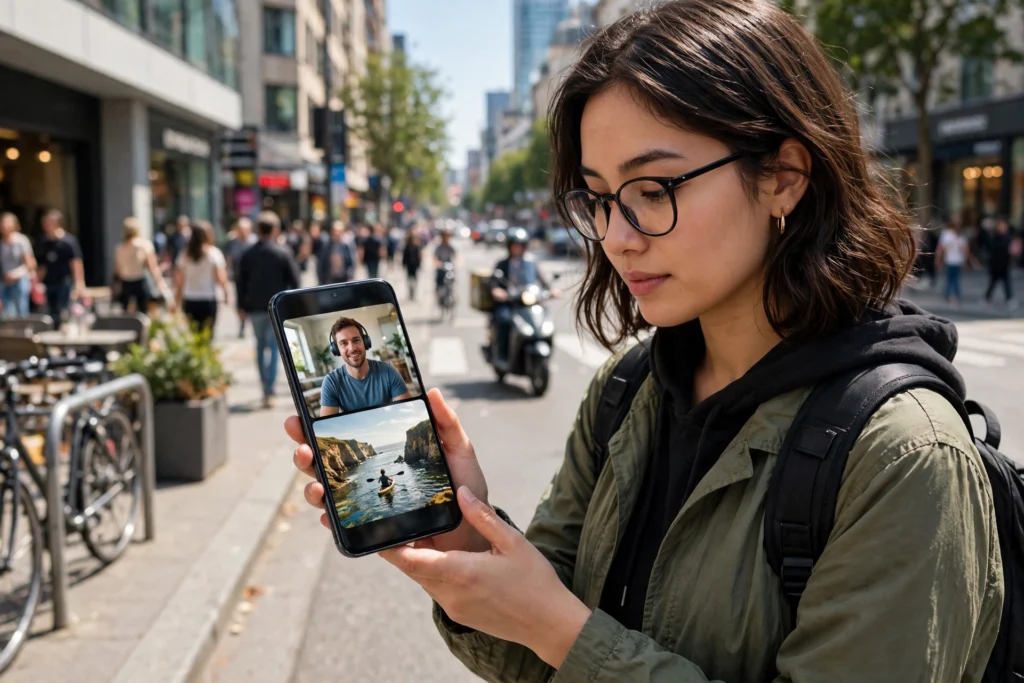
The benefits of 5G phones start with speed. A 5G phone can download a large app, a game update, or a high definition video in seconds rather than minutes when it has a strong mid band or mmWave signal. That benefit is most obvious for people who download large files on the move, work from a phone hotspot, or stream video at the highest quality.
The second benefit is capacity in crowded places. At a stadium, a concert, a train station, or a busy airport, thousands of phones compete for the same towers. 5G can serve more devices at once, and beamforming, a technique that focuses radio signals toward each device, helps keep connections stable when the crowd grows. This is why a 5G phone may still load maps at a packed event while a 4G phone buffers.
The third benefit is smoother real time use. Cloud gaming, video calls, and augmented reality apps need a steady, low delay connection more than peak speed. A 5G phone with good coverage can run a cloud game without a console or join a high definition video call from a park. Field workers can upload photos and forms from a site without waiting for WiFi, and a hotspot over 5G can back up a laptop during a home broadband outage. A 5G phone does not fix a slow website or a weak home router, and battery use can rise on a weak signal.
What Are Examples of 5G in Factories and Business?
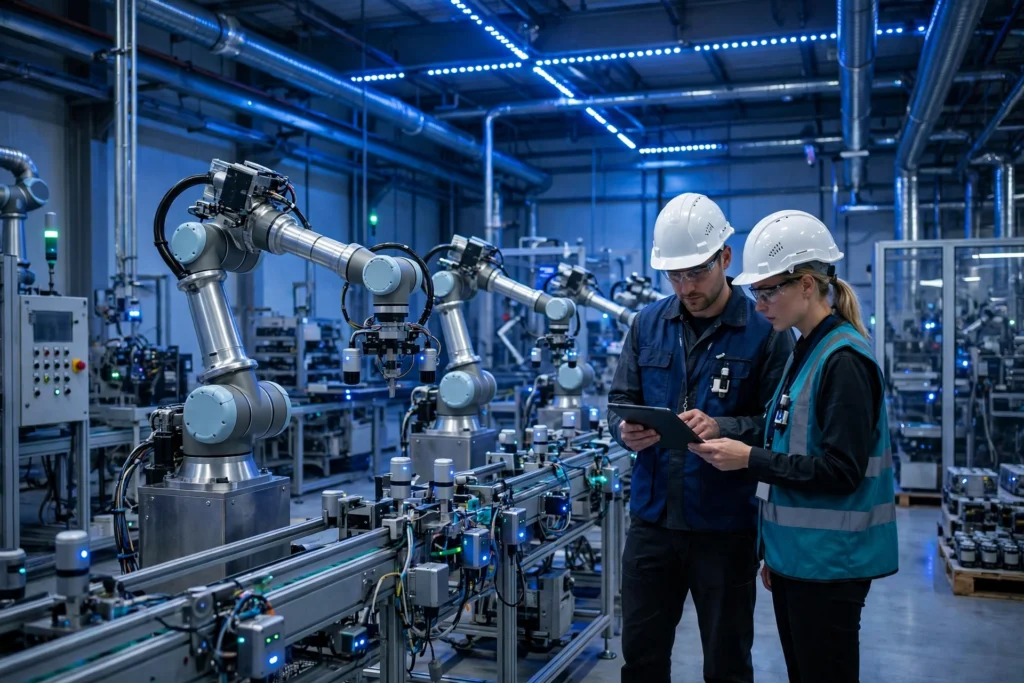
Factories offer some of the clearest examples of 5G in action because the value is easy to measure: less downtime, fewer defects, and faster changeovers. In a smart factory, private 5G networks connect robots, cameras, sensors, and control systems without cables that limit movement. A robot arm can receive control signals with very low delay, while a high resolution camera inspects parts in real time and flags defects at once.
Predictive maintenance is another strong factory example. Sensors on motors, pumps, and conveyor belts send vibration, temperature, and sound data to an analytics system. When the data shows a pattern that usually comes before a failure, the system warns the maintenance team early. Digital twins add a further layer: a live virtual model of a machine lets engineers test a change virtually, then apply the proven change to the real line.
Outside factories, businesses use 5G for fixed wireless branch connections, pop up retail sites, and remote offices. A shop, clinic, or construction site can get broadband through a 5G router without waiting for a wired installation. Logistics firms track shipments and vehicles with connected sensors, and managers can see delays as they happen.
What Are Examples of 5G in Healthcare?
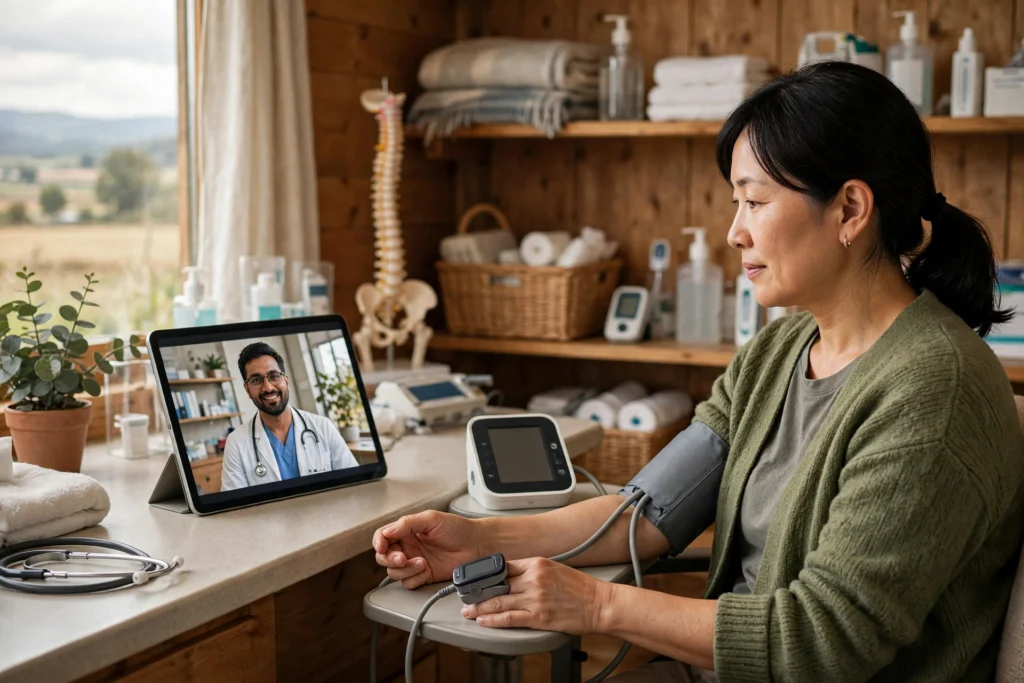
Healthcare is one of the most sensitive areas for 5G, and also one of the most promising, because it combines speed, reliability, and reach. The most common example today is high quality telemedicine. A doctor can hold a stable high definition video consultation with a patient in a rural area, review scans in real time, and guide a local nurse through an examination. Ambulances can send patient data and live video to the hospital while still on the road.
Remote patient monitoring is a second healthcare example. Wearable devices and home sensors can track heart rate, blood oxygen, and blood pressure, and send that data to a care team. 5G supports this monitoring at scale because it can connect many devices in one neighbourhood or hospital ward without overloading the network. The care team can spot a worrying trend early and contact the patient before a crisis develops.
Remote surgical assistance is the most advanced healthcare example, and it must be described accurately. In pilot projects, a specialist in another hospital can watch a high quality live feed of an operation and advise the team in the room. Researchers have also tested operating surgical robots over a 5G connection. These projects remain limited to controlled trials with strict safety checks.
What Are Examples of 5G in Smart Cities and Transport?
Smart cities use 5G to connect the systems that keep a city moving, safe, and efficient. Traffic is a leading example. Sensors at junctions measure vehicle flow, and adaptive traffic lights adjust their timing in real time to reduce congestion. Connected buses report their location accurately, so passenger apps show true arrival times. Emergency services can receive priority connectivity during a major incident, helping crews share video and location data without delay.
Transport beyond city streets also benefits. Connected vehicles can share warnings about sudden braking, road works, or icy patches with nearby cars and roadside units. This vehicle to everything communication, often called V2X, depends on low latency because a warning that arrives a second late may be useless. Fully driverless cars still need cameras, radar, lidar, and on board computing in addition to any network connection. Platooning, where trucks travel closely in a coordinated convoy to save fuel, is another transport example being tested on highways.
What Are Examples of 5G in Homes, Farming, and Energy?
Fixed wireless access is the most important home example of 5G. Instead of a cable or fibre line into the house, a 5G router receives broadband wirelessly from a nearby tower and shares it over WiFi inside the home. This can bring fast broadband to homes where fibre installation is slow, costly, or unavailable, and it can serve as a second connection for households that need a backup. Speed still varies with distance from the tower, building materials, and peak time load, so test a plan during any trial period. For readers comparing wireless options, the arrival of WiFi 7 is a useful companion topic, because home WiFi and mobile 5G solve different parts of the same problem.
Farming offers quiet but powerful examples. Soil sensors report moisture and nutrient levels, weather stations share local conditions, and drones capture crop images that reveal stress before it is visible from the ground. With 5G, these devices can send data from large fields in near real time, and farm equipment can adjust irrigation field by field. This precision farming approach can save water, reduce chemical use, and improve yields, especially on large farms where walking every field each day is not practical.
Energy and utilities use 5G for similar monitoring at scale. Smart grids balance supply and demand as solar and wind output changes through the day. Sensors along pipelines detect pressure drops that may signal a leak, and field crews can use augmented reality guidance during repairs.
What Are the Limits of 5G Today?
Coverage is the first limit. Low band 5G is now widespread in many countries, but faster mid band and mmWave coverage is still patchy outside cities. A phone may show 5G yet deliver speeds close to 4G because it is on low band. Indoor coverage can also disappoint, especially with mmWave, which struggles with walls and glass.
Device, plan, cost, and battery limits come next. Not every phone that says 5G supports every band, and not every plan includes full speed 5G. Some cheaper plans cap speed or limit hotspot use, and battery life can fall when a phone hunts for a weak signal. Security also needs attention: more connected devices mean more entry points, so strong passwords and software updates matter. If home WiFi is the weak link, start with basic troubleshooting, such as the steps for WiFi connected but no internet, before blaming the 5G network.
How Can You Check If 5G Is Worth It for You?
Start with your actual use. If you mainly browse, message, and stream standard video, good 4G may already be enough. If you download large files, work from a hotspot, game in the cloud, attend crowded events, or need a home broadband alternative, 5G is more likely to help. Write down the three places you use your phone most, then check coverage for those exact places rather than for your country as a whole.
Next, check your phone, plan, and total cost. Confirm that your phone supports the mid band frequencies your carrier uses, that your plan includes 5G at full speed, and that hotspot use is allowed if you need it. Test fixed wireless speeds at peak evening times, and include the phone, plan, and any router in the total cost.
Frequently Asked Questions
What are the benefits of 5G phones?
The benefits of 5G phones include faster downloads, smoother cloud gaming and video calls, better performance in crowded places, and a stronger hotspot for laptops. These benefits depend on mid band or mmWave coverage, a compatible phone, and a plan with full speed 5G.
Is 5G only about faster phones?
No, 5G is not only about faster phones. Examples of 5G also include fixed wireless home broadband, smart factories, remote healthcare, connected vehicles, smart city traffic systems, precision farming, and smart energy grids. Phones are the most visible example, but industry uses may matter more over time.
Does 5G drain battery faster?
5G can drain battery faster when the signal is weak, because the phone works harder to stay connected. Modern phones reduce this effect by switching to 4G when 5G adds no benefit. Strong coverage, updated software, and sensible settings usually matter more than the 5G icon itself.
Do I need a new phone for 5G?
Yes, you need a 5G capable phone to use a 5G network, and that phone must support the bands your carrier uses. An older 4G phone cannot connect to 5G, even on a 5G plan. Check the exact model and band list before you buy.
Is fixed wireless 5G as good as fibre broadband?
Fixed wireless 5G can match or beat slower wired plans, and it can be the best option where fibre is unavailable. Fibre usually wins on consistency, upload speed, and peak time stability. Test fixed wireless at your address during peak hours before you cancel a wired plan.
Is 5G safe?
Regulators and health agencies set exposure limits for radio frequencies, and 5G networks are designed to operate within those limits. Independent reviews have not established a proven health risk from 5G at levels below those limits. Security risks come mainly from connected devices and weak passwords, so keep software updated and use strong, unique passwords.
Conclusion
Examples of 5G are already part of daily life, even when they are invisible. A faster download, a stable video call in a crowd, a factory sensor that prevents a breakdown, a rural video consultation, and a traffic light that adapts to real flow all draw on the same network strengths: speed, low delay, and capacity for many devices. The most advanced examples are still growing, and honest limits on coverage, cost, and device compatibility should shape any buying decision.
Start with your own use, check coverage where you live and work, and choose a phone and plan that match that use. That simple check will tell you more than any headline speed claim.