How Does 5G Internet Work? A Simple Guide
Your phone shows 5G, a video loads in seconds, and a map updates before you reach the turn. It feels like magic, but how does 5g internet work in practice? The short answer is that 5G is the fifth generation of mobile network technology, and it carries your data as radio waves between your phone and a nearby cell site, then through fiber cables to the wider internet, using wider spectrum, smarter antennas, and a more flexible core network than 4G LTE.
That answer hides clever engineering. 5G combines a new radio technology, called 5G NR (New Radio), with more spectrum, denser cell sites, and software that can shape the network for different jobs. The result is faster typical speeds in many places, lower delay for interactive uses, and room for far more devices in one area. It is also uneven: the 5G you get depends on the band, the tower, the phone, the plan, and even the wall between you and the antenna.
Key Takeaways
- 5G internet moves data by radio waves from your device to a cell site, then by fiber to the internet, and back again.
- 5G NR, wider spectrum, Massive MIMO, beamforming, and small cells are the main reasons 5G can beat 4G LTE.
- Low band 5G gives wide coverage, mid band gives the best balance of speed and coverage, and high band millimeter wave gives extreme speed over short distances.
- The 5G icon on your phone does not guarantee a fast connection, because it can mean a connection that still leans on 4G.
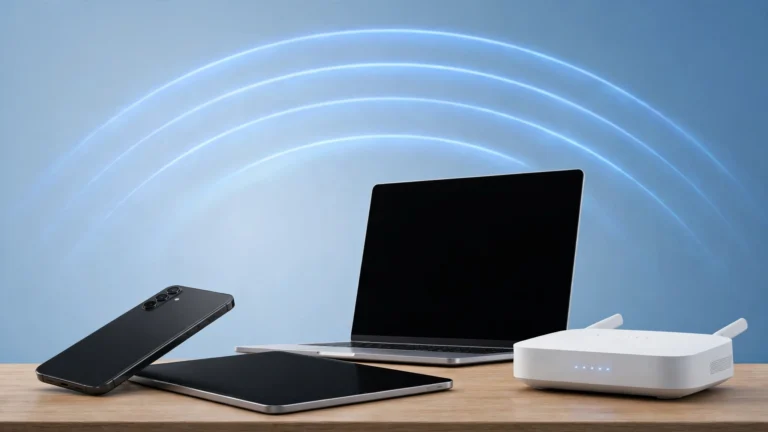
- 5G home internet uses a router with a SIM card to turn a cellular signal into home WiFi, and placement near a window often matters more than the router brand.
In this guide

- What is 5G internet, in simple terms?
- What does 5G mean on my phone?
- How does 5G internet work step by step?
- What are the three 5G spectrum bands?
- How do Massive MIMO and beamforming make 5G faster?
- Is 5G faster than 4G LTE, and what is the difference?
- How does 5G home internet work?
- What can you do with 5G, and what are its limits?
- How to check 5G support, and is it worth it?
- Frequently asked questions
What is 5G internet, in simple terms?
5G internet is internet access delivered over a fifth generation mobile network. It follows 1G, 2G, 3G, and 4G. Each generation changed what a phone could do well: 1G carried analog voice calls, 2G added digital voice and text, 3G made mobile data practical, and 4G, with its LTE (Long Term Evolution) standard, made smooth video streaming and app based life normal. 5G continues that story, with a focus on speed, responsiveness, capacity, and connecting many more devices at once.
The standard behind 5G is set by the 3rd Generation Partnership Project, usually called 3GPP. Its 5G NR air interface defines how phones and towers talk to each other over the air. Commercial 5G networks began going live in 2019, and by 2026 coverage is widespread in many countries, although the fastest bands are still concentrated in cities, stadiums, airports, and other busy places. It helps to separate mobile 5G, the service your phone uses away from home, from 5G home internet, also called fixed wireless access, which ends in a router inside your home. Note also that 5G is not WiFi: WiFi is a short range local network in your home, while 5G is a wide area network run by a carrier.
What does 5G mean on my phone?
When your phone shows 5G, it means your phone is connected to a 5G network, or at least to a network advertising 5G service. The icon is useful, but it is not a speed guarantee. Two phones in the same street can both show 5G and get very different speeds, because they may be on different bands, different towers, or different plans.
Part of the reason is how early 5G was rolled out. Many networks started as non standalone 5G, often written as NSA. In that setup, the phone uses 5G radio for data but still relies on a 4G LTE core network for control tasks. Standalone 5G, written as SA, uses a 5G core network as well as 5G radio, and it unlocks more advanced features, including network slicing and lower latency. You usually cannot tell from the icon alone which type you are on. Some phones show 5G plus or 5G UW (ultra wideband) to hint at a faster band, while others show a plain 5G icon for every band. A 4G only phone cannot use 5G at all, even on a 5G plan.
How does 5G internet work step by step?
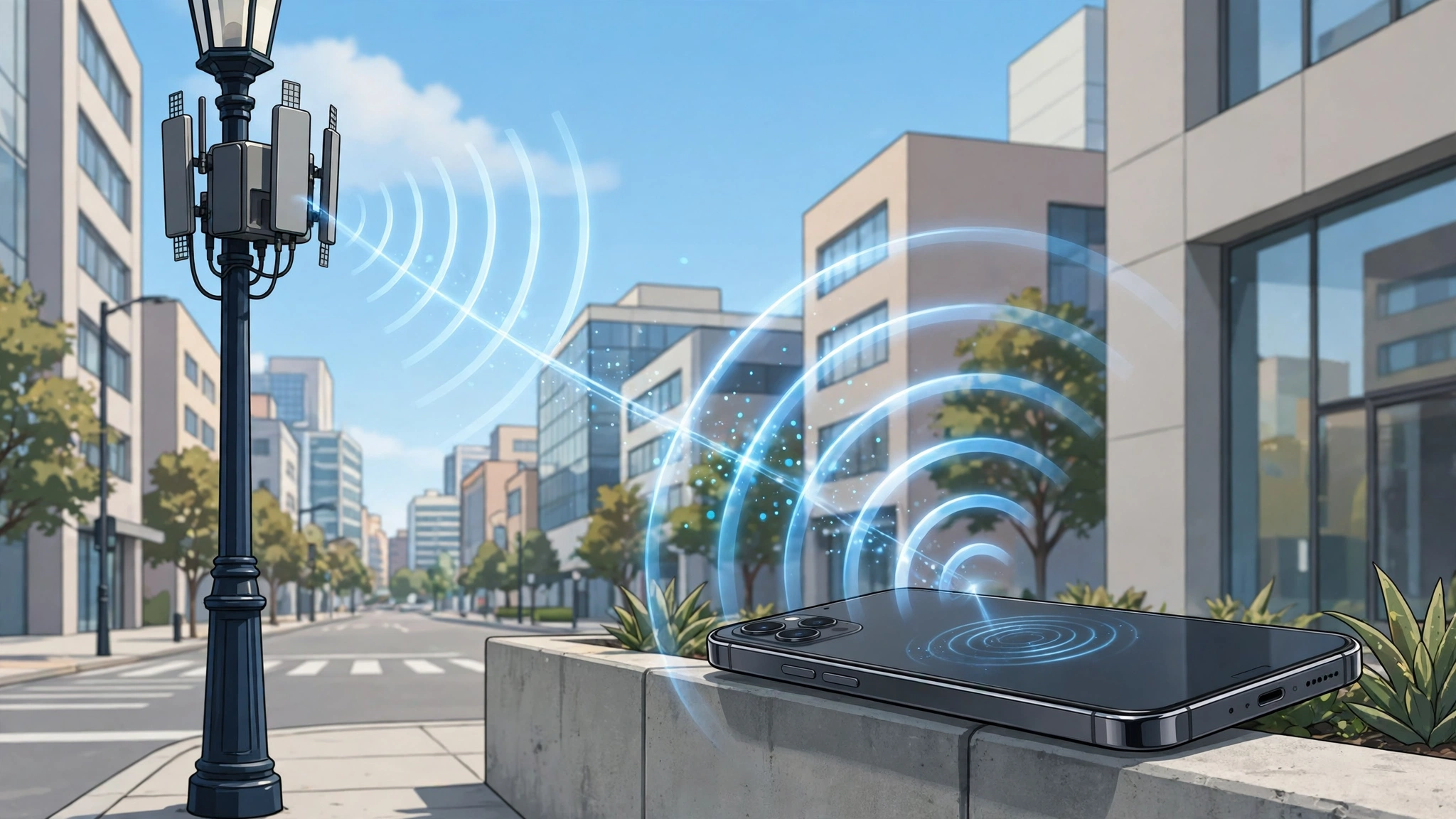
Follow one tap, such as opening a news article, and the journey has five stages. First, your device turns your tap into digital data and splits it into small packets, each carrying part of the request plus addressing information. Second, your device sends the packets by radio to the nearest suitable cell site, which may be a large macro tower on a rooftop or a small cell on a lamppost or building wall. The radio link uses 5G NR and OFDM (orthogonal frequency division multiplexing), a method that splits a signal across many closely spaced subcarriers to reduce interference and use spectrum efficiently.
Third, the cell site forwards the packets into the carrier core network, usually over fiber cables. This backhaul link is critical: a fast radio link means little if the tower itself connects to the internet through a slow link. The core network authenticates your device, checks your plan, and routes your traffic. Fourth, the packets travel across the wider internet to the server holding the article, video, or app data, which may sit in a data center far away or in a content node closer to you. Fifth, your device receives the returning packets, reassembles them, and displays the article. The whole round trip is measured in tens of milliseconds on a good connection. Latency is the name for that delay, and low latency matters most for video calls, cloud gaming, and remote control. Carrier aggregation, which combines several spectrum channels at once, and network slicing, which divides one physical network into virtual slices for different needs, make this journey smoother on 5G than on 4G.
What are the three 5G spectrum bands?
Spectrum is the range of radio frequencies a network is allowed to use, and 5G uses more of it, in more places, than any earlier mobile generation. Think of spectrum as road space: wider roads carry more traffic, but the type of road also decides how far traffic can travel. 5G networks combine three layers, and most real networks use a mix.
Low band 5G uses frequencies below 1 GHz, commonly around 600 MHz to 900 MHz. It travels far and passes through walls relatively well, so it is the coverage layer for rural areas, suburbs, and indoor spaces, but it is often only modestly faster than good 4G LTE. Mid band 5G uses frequencies roughly from 1 GHz to 6 GHz, with popular bands around 2.5 GHz and 3.5 GHz to 4 GHz. It is widely called the sweet spot, balancing speed and coverage and often reaching hundreds of megabits per second. High band 5G, also called millimeter wave or mmWave, uses frequencies above 24 GHz, commonly from 24 GHz to 47 GHz. It can deliver multi gigabit speeds in a good spot for stadiums and dense downtown streets, but it travels only short distances and is easily blocked by walls, windows, trees, and heavy rain, so it needs many small cells placed close together.
| Band | Frequencies | Range | Typical experience |
|---|---|---|---|
| Low band | Below 1 GHz | Long | Modest gain over 4G LTE |
| Mid band | 1 GHz to 6 GHz | Medium | Hundreds of megabits per second |
| High band (mmWave) | Above 24 GHz | Very short | Gigabit peaks in hotspots |
How do Massive MIMO and beamforming make 5G faster?
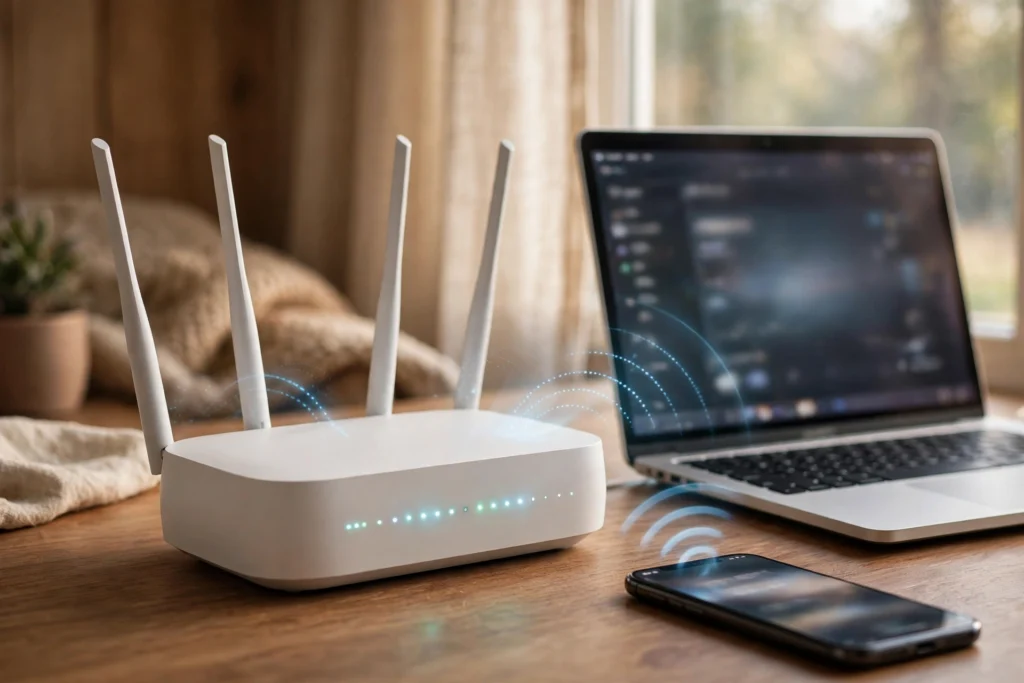
Spectrum alone does not explain 5G. The antennas changed too. A traditional 4G tower sector might use 2 to 8 antennas. A 5G tower using Massive MIMO (Multiple Input Multiple Output) can use 64, 128, or even more antenna elements in one array. More antennas mean the tower can send and receive many data streams at the same time, serve more users in the same area, and make better use of the same spectrum.
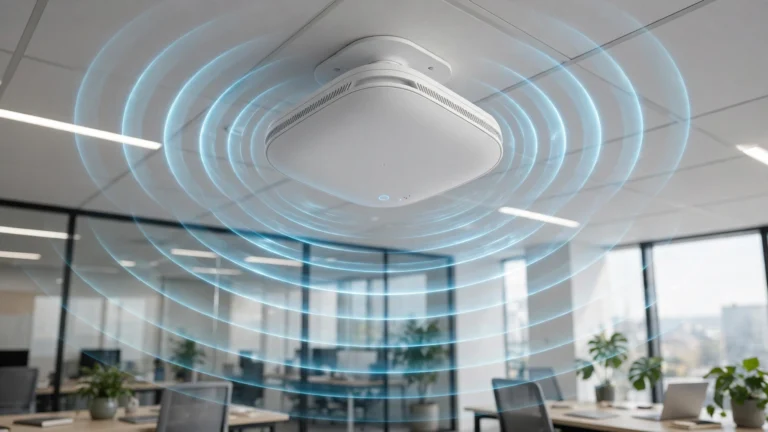
Beamforming works with Massive MIMO. Older mobile signals often broadcast broadly in all directions, like a floodlight. Beamforming focuses narrow beams of radio energy toward individual devices, like a spotlight following each user. That focus improves signal strength for the intended device, reduces interference for nearby users, and lets the network reuse the same spectrum more efficiently. Small cells complete the picture: compact, low power sites on lampposts, buildings, and poles in busy areas shorten the distance between your device and the network, which is exactly what high frequency signals need, and they add capacity where many people gather.
Is 5G faster than 4G LTE, and what is the difference?
In most real world tests, yes, but the size of the gain depends on the band. Low band 5G may feel only 20 percent to 30 percent faster than 4G LTE, a welcome gain but not a transformation. Mid band 5G often feels like a real step up, with typical downloads in the low hundreds of megabits per second. High band mmWave can reach gigabit speeds in ideal spots, but those spots are limited and the signal fades quickly as you move away or step indoors. Peak numbers in marketing deserve caution: the 5G standard allows theoretical peaks up to 20 gigabits per second, but real users rarely see those peaks, because peaks assume ideal spectrum, an empty cell, and a perfect signal.
Searchers often phrase it as the difference between 4g 5g, and the honest answer covers more than speed. 4G LTE was designed mainly for phones and tablets used for voice, messaging, browsing, and video. 5G was designed from the start for people, homes, vehicles, factories, and billions of sensors, all on the same flexible network. Technically, 5G NR adds wider channels, Massive MIMO at scale, beamforming, and a core network built for slicing and edge computing, which places processing closer to the user to cut latency, and it supports far higher device density, up to one million devices per square kilometer in the standard. A search for lte vs. 5g usually means the same comparison, with LTE as the 4G standard most people actually used. 5G NR is a new air interface, not a small LTE upgrade, which is why a 4G phone cannot be updated into a 5G phone by software alone. You may also see the odd phrase 5g vs 5g in keyword lists, but it is not a real comparison: it compares the same technology with itself, so the useful comparison is 5G against 4G LTE. Latency also improves, from often around 30 to 50 milliseconds on 4G LTE to around 10 milliseconds on 5G in good conditions.
How does 5G home internet work?
5G home internet, or fixed wireless access, turns a cellular signal into a home broadband connection. Instead of a cable or fiber line entering your house, a 5G router with a SIM card connects to a nearby cell site, just as a phone does. The router then shares that connection inside your home over WiFi and Ethernet cables. For more beginner friendly tech explainers, visit CPN Tech at https://www.cpntech.com/ and look for the networking guides in the Tech News and Hardware and Networking sections.
Setup is usually simple, but placement matters. Start by putting the router near a window facing the nearest tower, away from thick walls, metal objects, and large appliances. Many routers show signal strength on a screen or in an app, so move the router a little at a time and retest. A move of one meter, or from one window to another, can change speed dramatically, especially on mid band and mmWave. Once you find the best spot, test at different times of day, because evening congestion can lower speeds. 5G home internet suits renters who cannot get fiber installed, rural homes beyond cable reach, temporary homes, and households that want a backup connection. It suits fewer people when the signal is weak, the plan has a low data cap, or the household needs the consistently low latency and symmetrical upload speeds that fiber often provides. Before you switch, check coverage for your exact address, ask whether the plan is truly unlimited, and test at busy evening times. WiFi inside your home is still separate: a strong 5G signal will not fix a weak WiFi signal in a far bedroom. The guide to WiFi 7 vs WiFi 6 at https://www.cpntech.com/wifi-7-vs-wifi-6/ explains how the latest WiFi generation differs from the one before it.
What can you do with 5G, and what are its limits?
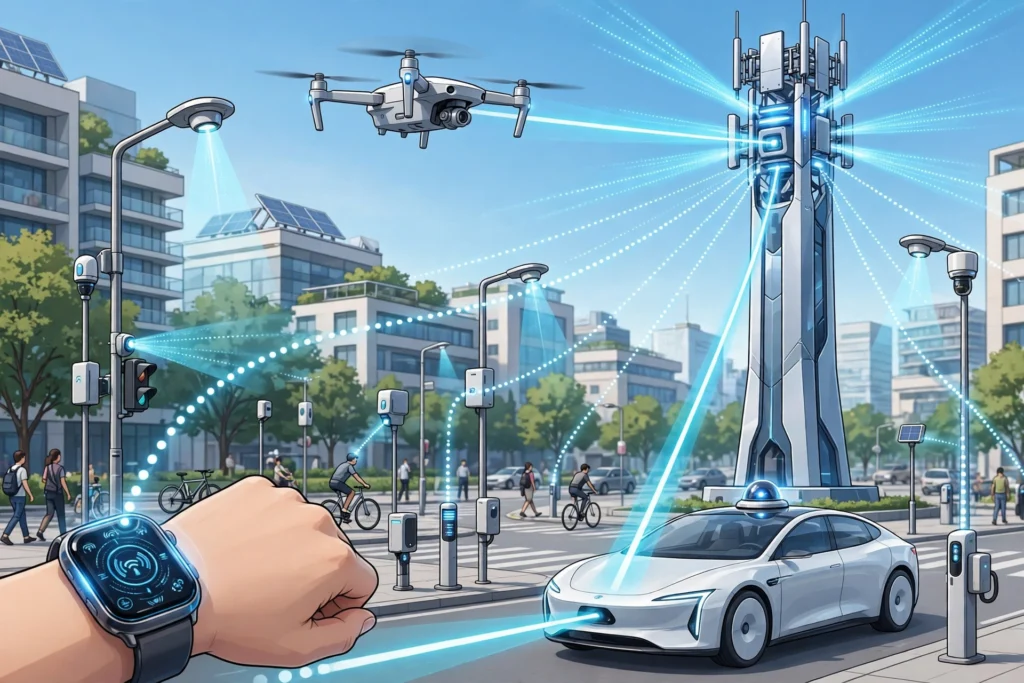
For most phone users, the everyday gains are smoother and more reliable, rather than revolutionary. High quality video starts faster and buffers less, large app updates finish sooner, video calls stay stable on the move, and crowded places work better. Cloud gaming and augmented reality benefit from lower latency, although they still depend on the app, the server, and the device, not only the network. Beyond phones, fixed wireless access brings broadband to homes without cables, smart city sensors can report traffic and air quality in real time, factories can connect robots and cameras without running cables to every machine, and connected cars can receive traffic updates, maps, and entertainment over 5G, although fully self driving cars rely mainly on onboard sensors and processing.
Limits are real. Mid band and especially mmWave need many more sites to cover the same area, so rollout is slow in rural areas. Higher frequencies also penetrate buildings poorly, so stepping indoors can drop a mmWave connection to mid band or 4G. A shared cell slows when many users stream at once, some plans limit 5G speed or reduce speed after a data allowance, and 5G radios can use more battery when searching for a weak signal.
How to check 5G support, and is it worth it?
Start with your phone settings: on Android, look under Settings, Network, or SIM settings for a preferred network type that includes 5G; on an iPhone, look under Settings, Mobile Data, then Voice and Data. If no 5G option appears, your phone may be 4G only, or your plan may not include 5G. Next, confirm in your carrier app that 5G is included, check the coverage map at your home and work addresses, then run a speed test with WiFi off in a few locations, repeating in the evening when networks are busiest. For home internet, check router position and whether WiFi reaches every room. Learning what an SSID is can help here, because the network name you see is the WiFi name your router broadcasts, not the 5G signal itself. The CPN Tech guide at https://www.cpntech.com/what-is-an-ssid/ explains that distinction in simple terms.
5G is worth it when it solves a real problem: strong mid band coverage, a phone that already supports 5G, a plan that includes it at little or no extra cost, and frequent streaming, gaming, or video calls. It is also worth it for a home without good cable or fiber options, if a trial shows stable speeds at busy times. Skip it for now if your 4G already handles everything you do, your area has only low band coverage, or you would need a new phone only for 5G. A 5G phone improves your connection away from home, while a better router improves your connection inside your home. For a sense of whether the newest wireless standard is worth the upgrade at home, see https://www.cpntech.com/is-wifi-7-worth-it/ before you spend.
Frequently asked questions
Does 5G use more data than 4G?
No. A one hour video at the same quality uses roughly the same amount of data on 4G and 5G. Faster speeds simply make it easier to choose higher quality video, download larger files, and use more apps, and those choices use more data. If your plan has a cap, watch video quality settings and automatic downloads.
Is 5G faster than home fiber?
Not usually. Fiber often gives more consistent speeds, lower latency, and symmetrical uploads, especially at busy times. 5G home internet can beat slow DSL or cable in some areas, and it can be a strong option where fiber is unavailable. For most homes with fiber available, fiber remains the better main connection, with 5G as a backup.
Why does my phone show 5G but feel slow?
The icon shows a connection, not a speed. You may be on low band 5G, on a congested cell, indoors behind thick walls, on a plan that limits speed, or on a non standalone network that still leans on 4G. Move near a window, test outdoors, try again at a quieter time, and compare with a speed test on WiFi.
Do I need a new SIM card for 5G?
Usually not, but it depends on your carrier and the age of your SIM. Many carriers support 5G on an existing SIM once your phone and plan support it. Some older SIMs need replacing, and some carriers issue a new SIM with a new phone or plan. Your carrier app or support team can confirm quickly.
Is 5G safe?
Regulators around the world set exposure limits for radio frequency energy, and 5G networks are designed to operate within those limits. The World Health Organization and national regulators state that, based on current evidence, exposure below those limits has not been shown to cause adverse health effects. For detail, check your national regulator.
Will 5G replace WiFi?
No. 5G and WiFi serve different jobs. 5G covers wide areas and keeps you connected on the move, while WiFi covers a home or office with a local network you control. Most homes will use both for years: 5G or fiber brings the internet to the house, and WiFi shares it inside.
Conclusion
How does 5g internet work? It works by turning your tap into packets, carrying those packets by radio to a nearby cell site, moving them over fiber through a carrier core network to the wider internet, and returning the answer along the same path. 5G NR, wider spectrum, Massive MIMO, beamforming, small cells, and a flexible core network make that journey faster, more responsive, and more capacious than 4G LTE, especially on mid band spectrum.
5G is a real upgrade, but its value depends on your band, your signal, your device, and your plan. Check coverage at your own address, test speeds at busy times, place a home router carefully, and upgrade when the evidence supports it. Done that way, 5G becomes a practical tool: faster when it matters, steadier in crowds, and a genuine option for homes beyond the reach of cable and fiber.