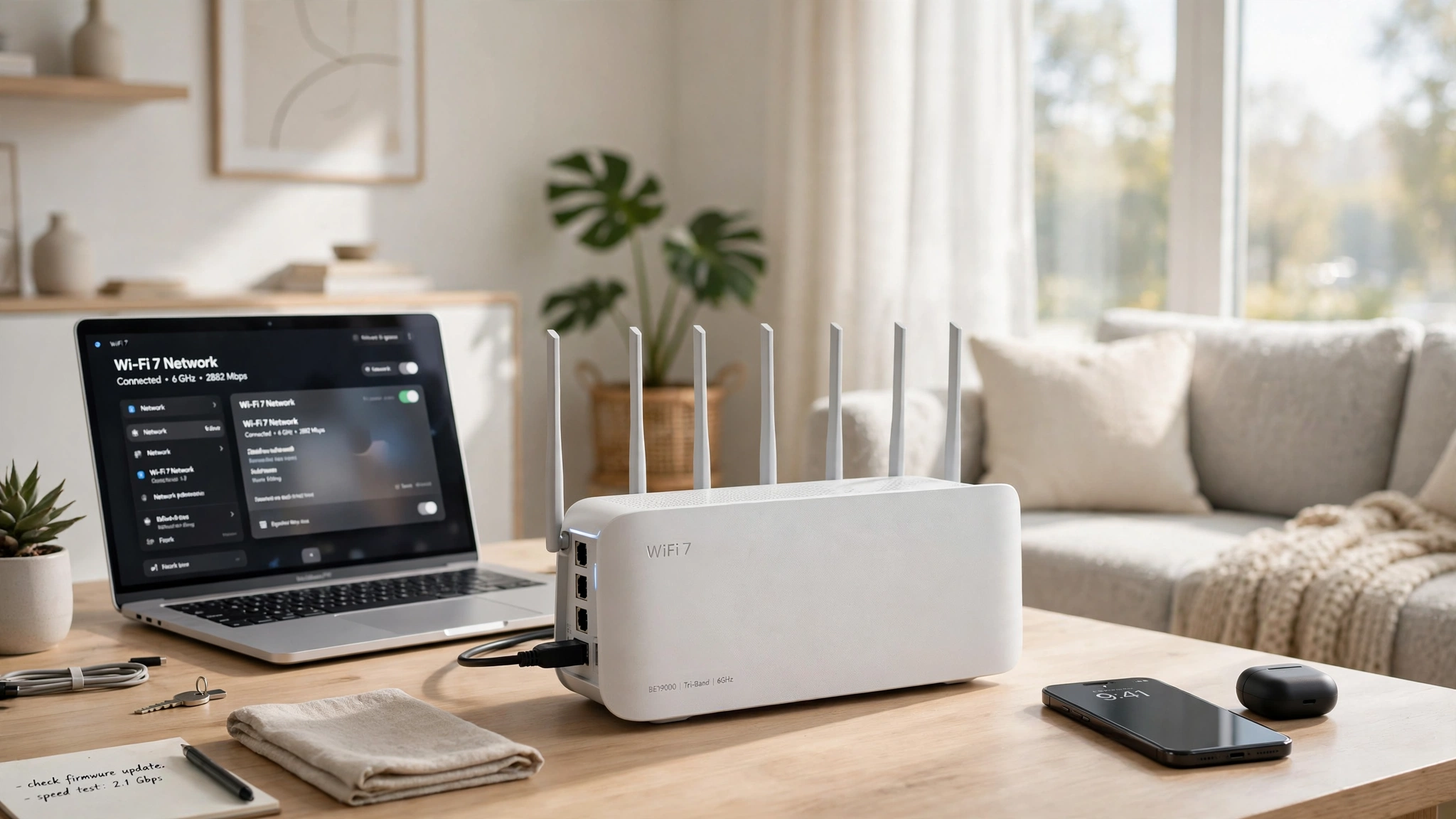
When Did WiFi 7 Come Out? Full Release Timeline
WiFi 7 came out on January 8, 2024, when the Wi-Fi Alliance launched its Wi-Fi Certified 7 program. That date is the cleanest answer, because certification is the moment manufacturers could prove their products met a common Wi-Fi 7 standard and carry the official Wi-Fi 7 label. If you see a different year elsewhere, it usually describes a different milestone, not a contradiction.
Some WiFi 7 routers reached shops in 2023 using draft specifications, before certification existed. The underlying IEEE 802.11be standard was not fully ratified until July 2025. So WiFi 7 has three honest release dates: first draft products in 2023, official certification on January 8, 2024, and final IEEE ratification in July 2025. For most buyers, January 2024 is the date that counts.
Key Takeaways
- WiFi 7 was officially certified on January 8, 2024, by the Wi-Fi Alliance at CES 2024.
- First draft-based WiFi 7 routers appeared in mid to late 2023, before certification.
- WiFi 7 is the marketing name for IEEE 802.11be, also called Extremely High Throughput (EHT).
- IEEE fully ratified 802.11be in July 2025, after products were already on sale.
- WiFi 7 uses the 2.4 GHz, 5 GHz, and 6 GHz bands, with channels up to 320 MHz in 6 GHz.
- By 2025 and 2026, WiFi 7 moved from premium routers to mainstream phones, laptops, and mesh systems.
- When Did WiFi 7 Come Out?
- Why Are There Three Different WiFi 7 Release Dates?
- How Did WiFi 7 Develop, Step by Step?
- What Changed in WiFi 7 Compared With WiFi 6 and WiFi 6E?
- When Did the First WiFi 7 Routers and Devices Arrive?
- When Did WiFi 7 Reach Ordinary Buyers?
- How Does the WiFi 7 Rollout Compare With Earlier Generations?
- Should You Buy WiFi 7 Now, or Wait?
- Common Mistakes About the WiFi 7 Release Date
- Frequently Asked Questions
- Conclusion
When Did WiFi 7 Come Out?
WiFi 7 came out on January 8, 2024. On that day, the Wi-Fi Alliance, the industry body that certifies Wi-Fi products for interoperability, announced Wi-Fi Certified 7 at CES 2024 in Las Vegas. From that point, routers, phones, laptops, and other devices could be tested against the same Wi-Fi 7 requirements and carry the same label.
Certification matters because it gives buyers an independent guarantee. Before certification, a manufacturer could describe a product as WiFi 7 based on a draft of the standard, but there was no guarantee it would work smoothly with WiFi 7 products from other brands. Certification gave that guarantee, and it gave retailers a clear label for boxes. That is why January 2024 is the date most guides treat as the official launch.
At launch, the Wi-Fi Alliance said smartphones, PCs, tablets, and access points would be among the earliest Wi-Fi 7 products. Its early forecast expected 233 million Wi-Fi 7 devices to enter the market in 2024, growing to 2.1 billion devices by 2028. When you check a product today, look for the Wi-Fi Certified 7 mark, or a clear statement that it supports IEEE 802.11be. A model name containing BE, such as BE19000, also signals WiFi 7, because BE is the code for 802.11be.
Why Are There Three Different WiFi 7 Release Dates?
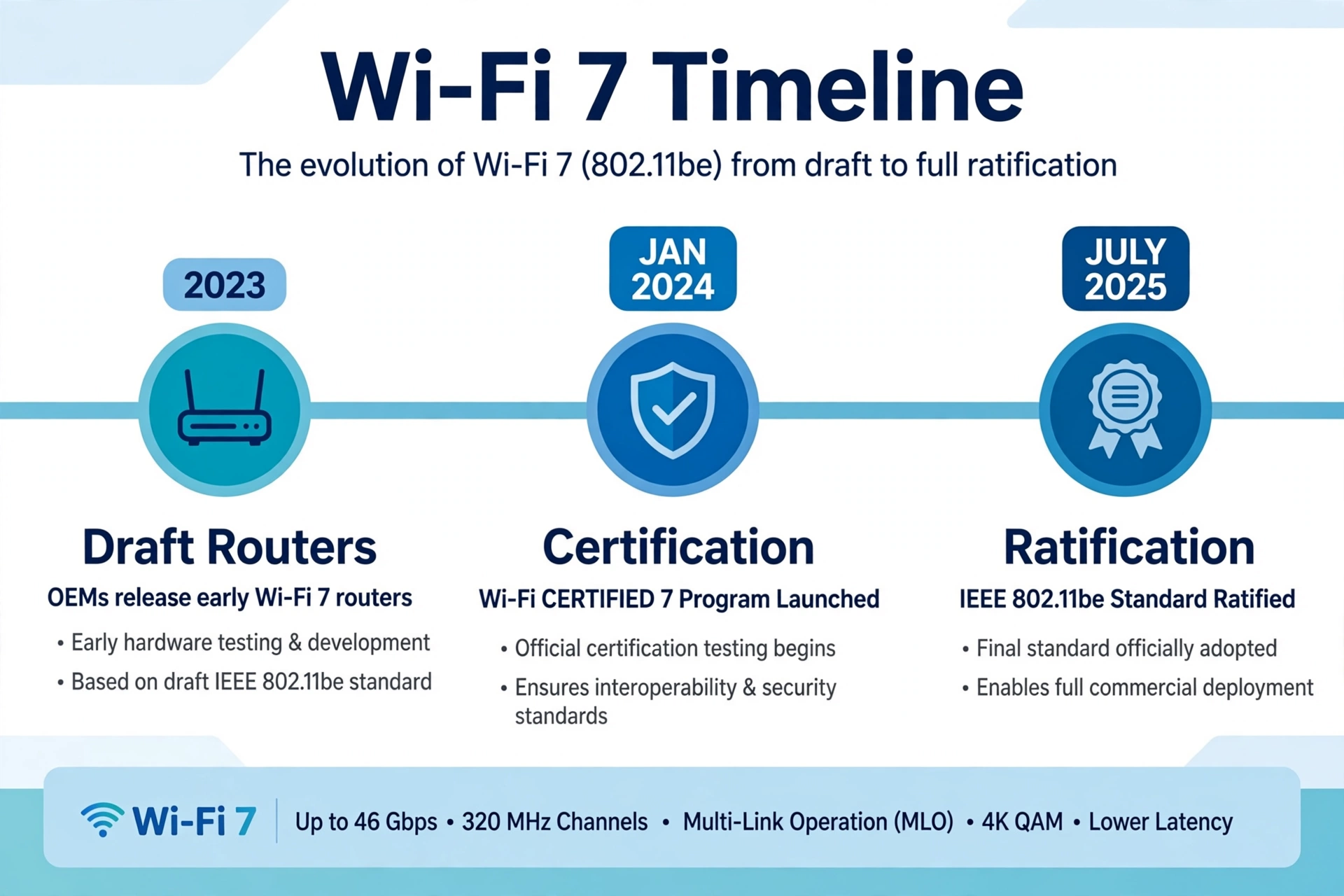
Search results give different WiFi 7 dates because wireless standards are not released in a single moment like a phone launch. They pass through three stages, and each stage has its own date.
The first stage is draft products. Manufacturers often build hardware from a nearly finished draft, months before it is final, so they can be first to market. The first WiFi 7 routers appeared in mid to late 2023 on this basis. They were real products at real prices, but they might need a firmware update if the final standard changed.
The second stage is certification. On January 8, 2024, the Wi-Fi Alliance launched Wi-Fi Certified 7. This is the stage most people mean when they ask when WiFi 7 came out. Certification tests products against agreed features, so a certified router and a certified phone can be expected to work together using WiFi 7 features.
The third stage is ratification. The Institute of Electrical and Electronics Engineers, known as IEEE, writes the technical standard itself, IEEE 802.11be. IEEE fully ratified 802.11be in July 2025. Ratification can lag behind certification because the Wi-Fi Alliance certifies the features that matter most to buyers, while IEEE finalises every technical detail. None of these dates is wrong: 2023 is when you could first buy one, 2024 is when it became official, and 2025 is when the standard was fully finished.
How Did WiFi 7 Develop, Step by Step?
WiFi 7 grew out of several years of work inside IEEE, followed by a fast commercial rollout. The timeline below puts the key milestones in order.
| Year | Milestone |
|---|---|
| 2019 | Wi-Fi 6 certification begins, and work on its successor, 802.11be, gathers pace inside IEEE. |
| 2021 | WiFi 7 is widely discussed, with early proposals for wider channels and multi-link operation. |
| 2023 | First draft-based WiFi 7 routers reach the market, led by TP-Link, ASUS, and NETGEAR. |
| January 8, 2024 | Wi-Fi Alliance launches Wi-Fi Certified 7 at CES 2024, the official release date. |
| 2024 | First certified phones, laptops, and mesh systems ship in volume. |
| 2025 | WiFi 7 spreads to mid-range routers and more phones and laptops; IEEE ratifies 802.11be in July. |
| 2026 | WiFi 7 becomes a mainstream option in new routers, mesh systems, and flagship devices. |
The speed of this rollout surprised some observers. Dong Knows Tech noted that, by early 2025, just one year after certification, there were already more WiFi 7 hardware models being released or announced than Wi-Fi 6 and Wi-Fi 6E models combined, by its unofficial count. Draft products also proved stable enough that most buyers could buy in 2024 without worrying that their router would become obsolete when IEEE finished its work in 2025.
What Changed in WiFi 7 Compared With WiFi 6 and WiFi 6E?
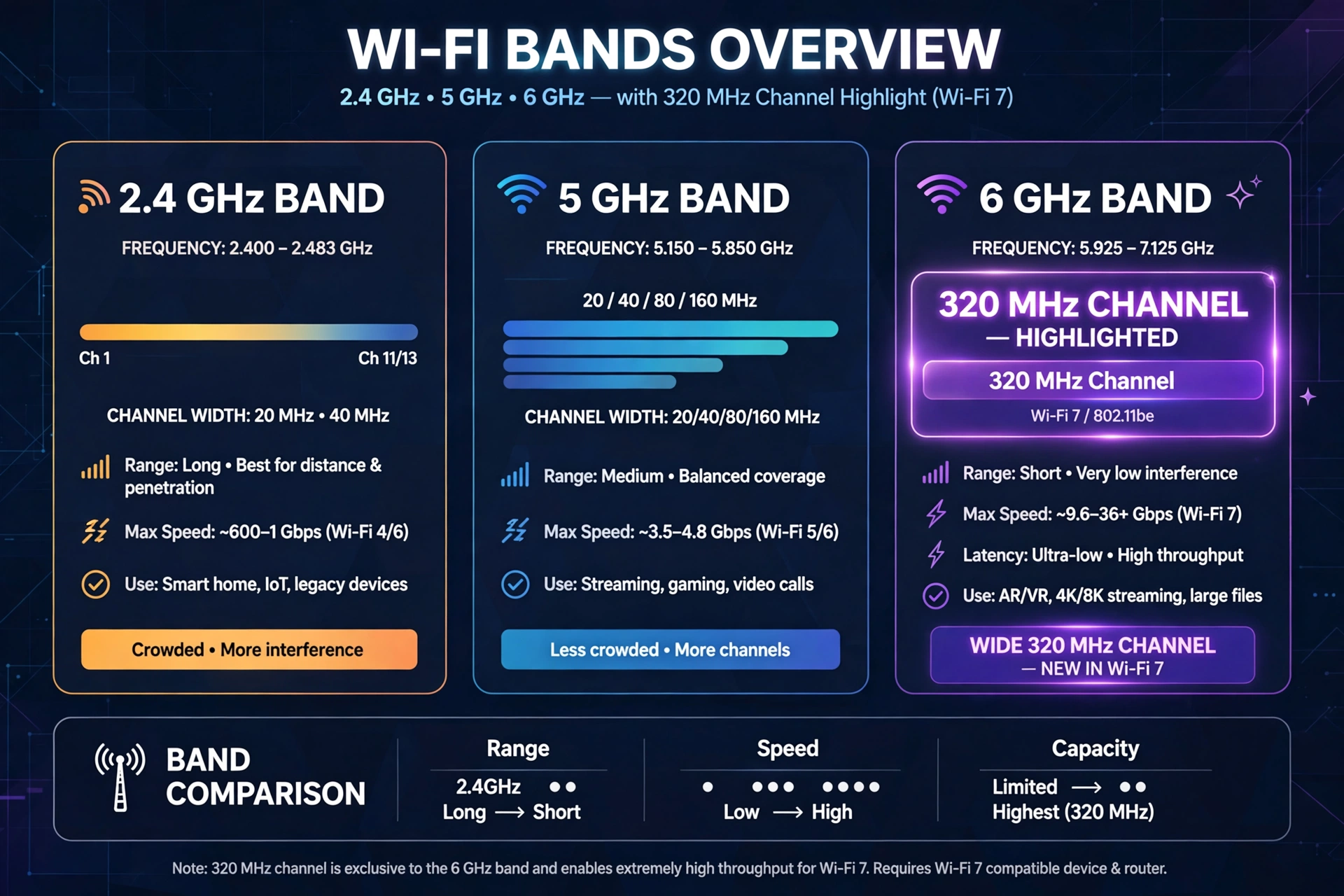
WiFi 7 changes how a router uses radio spectrum, how it talks to several devices at once, and how it keeps a connection stable when one band gets crowded. The five changes below explain why it matters, beyond its headline speed.
- Wider channels: WiFi 7 doubles the widest channel from 160 MHz to 320 MHz, but only in the 6 GHz band, where there is enough clean spectrum. This is the main reason it can claim theoretical speeds of up to 46 Gbps, versus 9.6 Gbps for Wi-Fi 6.
- Higher modulation: WiFi 7 uses 4096-QAM, up from 1024-QAM in Wi-Fi 6. Higher QAM packs more data into each radio signal, which raises speed when the signal is strong, such as when you are close to the router.
- Multi-Link Operation (MLO): older Wi-Fi devices connected on one band at a time. MLO lets a device use two or more bands at the same time, for example 5 GHz and 6 GHz together, so traffic can move bands without dropping if one band becomes congested.
- More streams: WiFi 7 supports 16 spatial streams through 16×16 MU-MIMO, up from 8×8 in Wi-Fi 6, so a router can talk to several devices at the same time more effectively.
- Puncturing: WiFi 7 can work around a busy part of a channel and still use the rest, which makes wide 320 MHz channels practical in real homes, not just in laboratory tests.
Together, these changes explain why WiFi 7 feels different from Wi-Fi 6E. Wi-Fi 6E mainly added the 6 GHz band to Wi-Fi 6. WiFi 7 keeps all three bands, 2.4 GHz, 5 GHz, and 6 GHz, and changes how they are used together. For a fuller look at whether the upgrade is worth it, read our guide on is WiFi 7 worth it.
When Did the First WiFi 7 Routers and Devices Arrive?
The first WiFi 7 routers arrived in 2023, before certification, and the first certified devices followed quickly in early 2024. In mid to late 2023, TP-Link, ASUS, and NETGEAR were among the first brands to sell WiFi 7 routers based on draft specifications. These early models were expensive, often aimed at enthusiasts, with flagship models commonly exceeding 500 dollars.
At CES 2024, the launch of Wi-Fi Certified 7 brought a wave of announcements. The NETGEAR Nighthawk RS700S, priced around 699 dollars at launch, and the TP-Link Archer BE800, priced around 300 dollars, showed how wide the early price range already was. The Amazon eero Max 7, priced around 599 dollars, brought WiFi 7 to the mesh market, where several units work together to cover a whole home.
Phones and laptops followed routers, as they usually do. Flagship phones in 2024 began to include WiFi 7 radios, followed by premium laptops. By 2025, WiFi 7 support had spread to a wider range of phones and laptops, though it remained more common in higher priced models. If you want to check which gadgets support the standard today, see our guide to what devices support WiFi 7.
When Did WiFi 7 Reach Ordinary Buyers?

Certification in January 2024 did not instantly make WiFi 7 cheap or universal. It made WiFi 7 official, and then prices, availability, and ISP support caught up over the next two years. That gap between official launch and ordinary availability is normal for every Wi-Fi generation.
In 2024, WiFi 7 was mainly a premium purchase. You could buy a certified router, but you paid a premium, and you needed WiFi 7 devices to see the full benefit. Many buyers in 2024 still chose Wi-Fi 6 or Wi-Fi 6E routers, because those routers were cheaper and their existing phones and laptops could not use WiFi 7 features anyway.
In 2025, the picture changed. Mid-range WiFi 7 routers appeared, mesh systems became more affordable, and more phones and laptops shipped with WiFi 7 as standard in their price range. Internet providers also began to offer WiFi 7 routers to new customers, which is often how a new standard reaches people who never shop for a router themselves. By 2026, WiFi 7 is a mainstream option in new hardware. Wi-Fi 6 routers are still sold and still fast enough for many homes, but when you buy a new flagship phone, a premium laptop, or a new mesh system in 2026, WiFi 7 support is a reasonable expectation. Regional availability still varies, because the 6 GHz band is not open in exactly the same way in every country. For homes that need coverage across several rooms, our guide to WiFi 7 mesh systems explains when a mesh system is worth the extra cost.
How Does the WiFi 7 Rollout Compare With Earlier Generations?
WiFi 7 followed the same basic pattern as earlier generations, but it moved faster from certification to mainstream products than Wi-Fi 6 did. The table below compares the generations in simple terms.
| Generation | Standard | Certification or release year | Theoretical maximum speed |
|---|---|---|---|
| Wi-Fi 4 | 802.11n | 2009 | 600 Mbps |
| Wi-Fi 5 | 802.11ac | 2014 | 3.5 Gbps |
| Wi-Fi 6 | 802.11ax | 2019 | 9.6 Gbps |
| Wi-Fi 6E | 802.11ax with 6 GHz | 2021 | 9.6 Gbps |
| Wi-Fi 7 | 802.11be | 2024 | 46 Gbps |
Two patterns stand out. First, the gap between generations has stayed around five years, but Wi-Fi 6E arrived in between, so buyers saw a new label every two to three years in the 2020s. Second, theoretical speeds have grown far faster than typical home internet speeds. A 46 Gbps router does not give you 46 Gbps internet, because your internet plan, often 100 Mbps to 1 Gbps, is the bottleneck for downloads from the internet. WiFi 7 improves the local network inside your home, which matters for transfers between devices, gaming, and handling many devices at once, even when your internet plan stays the same. Earlier generations also had draft products before certification, but with WiFi 7 draft products were more visible and more widely reviewed, so more buyers encountered the gap between available and certified.
Should You Buy WiFi 7 Now, or Wait?
By 2026, the question is no longer whether WiFi 7 exists. It does, it is certified, and it is widely available. The real question is whether it solves a problem you actually have.
Buy WiFi 7 now if you are already replacing your router, and the price difference over a good Wi-Fi 6E router is small. In that case, WiFi 7 gives you a longer useful life, because your next phone or laptop is likely to support it. Buy it if you have a fast internet plan, above 1 Gbps, or if your home is crowded with devices, or if you game, stream in 4K or 8K, or use virtual reality, where low latency matters.
Wait if your current router works well, your internet plan is below 500 Mbps, and most of your devices are Wi-Fi 5 or Wi-Fi 6. A new router will not make your internet plan faster, and older devices cannot use WiFi 7 features. In that case, better router placement, a mesh system, or a wired connection for a gaming PC or television will often help more than a WiFi 7 label. When you do buy, check three things: that the router is Wi-Fi Certified 7, not just draft-based; that your main devices support WiFi 7, or that you plan to upgrade them soon; and whether your country allows the full 6 GHz band. A wired connection still beats any Wi-Fi generation for a fixed device near the router. If you want to understand that wired alternative, read our guide on what is Ethernet. Many of the best home networks in 2026 combine both: Ethernet for fixed devices, and WiFi 7 for phones, laptops, and everything that moves.
Common Mistakes About the WiFi 7 Release Date
Several mistakes repeat across guides and comment sections, and they lead buyers to wrong conclusions.
- Treating the first router sale as the official release: draft routers in 2023 were real, but they were not certified, so using 2023 as the headline date overstates how ready WiFi 7 was.
- Treating IEEE ratification in July 2025 as the release date: by July 2025 millions of WiFi 7 devices were already in use, so calling 2025 the release date would imply WiFi 7 did not exist in 2024.
- Confusing theoretical speed with real speed: WiFi 7’s 46 Gbps figure is a laboratory maximum. A typical home router delivers far less, often a few gigabits per second at best.
- Assuming a WiFi 7 router automatically upgrades every device: it does not. A Wi-Fi 6 phone connected to a WiFi 7 router still uses Wi-Fi 6. You need both ends to support WiFi 7.
- Assuming WiFi 7 fixes a slow internet connection: it cannot. If your internet plan is slow, a new router will not fix it. Test with a wired connection and check your plan speed first.
Frequently Asked Questions
When did WiFi 7 come out?
WiFi 7 came out on January 8, 2024, when the Wi-Fi Alliance launched Wi-Fi Certified 7 at CES 2024. Draft-based routers had appeared in 2023, and IEEE fully ratified the 802.11be standard in July 2025, but January 2024 is the official certification date most guides use as the release date.
Is WiFi 7 the same as 802.11be?
Yes. WiFi 7 is the simple marketing name for IEEE 802.11be, also called Extremely High Throughput (EHT). You will see BE in router model names, such as BE19000, because BE is the code for 802.11be. Wi-Fi Certified 7 is the Wi-Fi Alliance program that tests products against that standard.
When did the first WiFi 7 router come out?
The first WiFi 7 routers came out in mid to late 2023, based on draft specifications, before certification. Brands such as TP-Link, ASUS, and NETGEAR led the early launch. The first certified routers followed in early 2024, after the Wi-Fi Alliance launched Wi-Fi Certified 7 on January 8, 2024.
When was WiFi 7 fully finished?
WiFi 7 was fully finished in July 2025, when IEEE ratified the 802.11be standard. Certification in January 2024 covered the features buyers need, so products could ship and be certified before every technical detail was finalised. Firmware updates covered any remaining differences for early products.
Do I need WiFi 7 in 2026?
You need WiFi 7 in 2026 only if it solves a real problem in your home, such as a very fast internet plan, many connected devices, or latency sensitive gaming and virtual reality. If your current router works well and your devices are older, a good Wi-Fi 6 router remains enough. Upgrade when you replace your router, not just for the label.
Will a WiFi 7 router make my internet faster?
A WiFi 7 router will not make your internet plan faster, because your provider sets that speed. It can make your local wireless network faster and more reliable, especially for transfers inside your home and for many devices at once. If your wired speed is already slow, fix your plan or provider first.
Conclusion
WiFi 7 came out on January 8, 2024, when the Wi-Fi Alliance launched Wi-Fi Certified 7. That is the date to remember, but the full story is richer: draft routers in 2023, certification in 2024, and final IEEE ratification in July 2025. Each date marks a different stage, and together they explain why different guides seem to disagree.
By 2026, WiFi 7 has moved from a premium novelty to a mainstream option, with wider channels, Multi-Link Operation, and better handling of crowded homes. It will not fix a slow internet plan, and it will not upgrade devices that do not support it, but for buyers replacing a router, or building a home full of new devices, it is now a sensible, future proof choice. When you shop, check for certification, check your devices, and check your local 6 GHz rules, and you will get the benefit WiFi 7 was designed to deliver.
For more simple explanations of home networking, visit the CPN Tech homepage, where new guides are published every day.